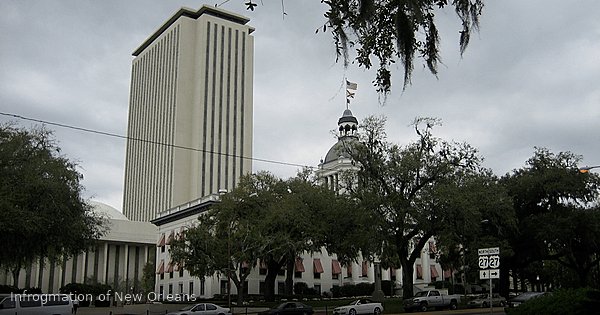
The Florida Supreme Court on Friday shut the door on a legal challenge aimed at blocking Gov. Ron DeSantis from convening a special legislative session to redraw the state's congressional maps. The court's decision was unanimous, and it wasn't close on the reasoning, either.
Two Florida voters, backed by the National Redistricting Foundation, had petitioned the court to halt DeSantis' call for a special session starting April 20 and to block Secretary of State Cord Byrd's decision to push the congressional qualifying week from April to June. Chief Justice Carlos Muñiz dispatched both requests in a short, two-paragraph ruling, finding them beyond the scope of the petition filed.
The legal reasoning was straightforward. Muñiz wrote:
"The Governor has the authority to convene the Legislature in special session by proclamation."
"The Secretary of State is the chief election officer of the state and has the authority to interpret the election laws."
That's not a novel constitutional interpretation. That's Florida law, stated plainly by the state's highest court. The governor can call a special session. The secretary of state can manage election timelines. The petitioners asked the court to invent a limitation that doesn't exist, and the court declined.
DeSantis called the special session in January to redraw Florida's 28 U.S. House districts. His reasoning centers on a pending U.S. Supreme Court ruling on a redistricting case out of Louisiana. DeSantis believes that ruling will strike down part of the Voting Rights Act, and claims that outcome would require Florida to redraw some of its districts in response.
That's a proactive move, not a reactive one. Rather than waiting for a Supreme Court decision to land and then scrambling to adjust maps under compressed timelines, DeSantis is positioning Florida's Legislature to act immediately. Secretary of State Byrd's decision to move the qualifying week back to June creates the calendar space necessary to make that possible.
President Trump has called on GOP-led states to redraw their districts ahead of the midterm elections to prevent Democrats from taking the U.S. House. Texas has already done so. Some Democratic-led states like California have followed suit with their own redraws. Others, including Republican-controlled Indiana and Democratic-led Maryland, have resisted.
Florida is choosing to act.
Justice Adam Tanenbaum, who was appointed to the bench in January by DeSantis, wrote a separate concurrence making a finer procedural point: since the court did not consider the underlying merits of the petition, it should have been dismissed rather than rejected. The distinction matters in legal terms, dismissal signals a jurisdictional or procedural deficiency, while rejection can imply a merits determination.
Tanenbaum's concurrence underscores just how weak the petition was. The court didn't even need to reach the substance of the arguments to dispose of it.
The National Redistricting Foundation supported this challenge, and it's worth pausing on what they were actually asking for. They wanted the Florida Supreme Court to strip the governor of his explicit constitutional authority to call a special session and to overrule the secretary of state's management of election calendars, not because either official exceeded their authority, but because the petitioners didn't like the purpose for which that authority was being exercised.
That's not a legal argument. It's a political objection dressed in legal clothing. The court saw through it immediately.
This is the pattern with redistricting fights nationwide. When Republicans draw maps, it's gerrymandering. When Democrats draw maps, it's representation. The legal machinery gets deployed not to enforce neutral principles but to freeze favorable maps in place. Florida voters approved an anti-gerrymandering amendment back in 2010, and the state operates under that framework. But the amendment doesn't prohibit the Legislature from redrawing maps when legal circumstances change, which is precisely what DeSantis argues is about to happen.
The special session is set to begin April 20, while lawmakers are already in the middle of their regular 60-day session. House Speaker Daniel Perez, a Miami Republican, convened a special committee last fall to examine the redistricting question, but the panel didn't produce any proposals. The special session gives the process a hard deadline and a clear mandate.
Whether the Legislature produces maps that reshape Florida's congressional delegation depends on what the U.S. Supreme Court does with the Louisiana case, and on how aggressively Florida lawmakers choose to act within whatever new legal landscape emerges.
The court cleared the path. The session is set. The only people surprised by Friday's ruling are the ones who thought a two-paragraph petition could override the Florida Constitution.

